From Bulletin Boards and Chat Rooms to Early Online Communities
Long before social media, text on a screen was enough to build genuine community. Bulletin board systems, or BBSs, emerged in the late 1970s and grew steadily through the 1980s, allowing users with dial-up modems to post messages, share files, and argue about everything from software to politics. Usenet, launched in 1980, extended this further into a sprawling network of topic-specific newsgroups where pseudonyms were the norm and niche interests found surprisingly dedicated audiences.
By the mid-1990s, Internet Relay Chat and AOL's chat rooms introduced real-time exchange, which felt genuinely new. Anonymity shaped behavior in complicated ways – liberating for some, chaotic for others. Moderators held real power, and platform rules varied wildly. Slow connections and uneven access kept these spaces smaller than they might otherwise have been.
The Social Web Transformed Digital Interaction
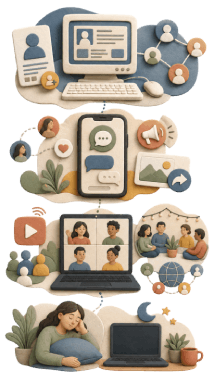
Platforms like Friendster and MySpace, arriving in the early 2000s, pulled online socializing away from anonymous topic-based forums toward something more personal. Users built profiles, assembled friend lists, and performed identity publicly. Facebook, launched in 2004, refined this model and scaled it globally; by 2008, it had over 100 million users. Twitter added a broadcast dimension, letting individuals address audiences rather than just networks.
What shifted wasn't only the platforms. Mobile devices meant social interaction traveled everywhere, erasing the distinction between being "online" and simply being present. Messaging apps like WhatsApp extended this further, drawing older demographics in.
Participation stopped being a specialized habit. Digital socializing became ordinary infrastructure, as routine as a phone call.
Video Calls, Virtual Events, and Remote Hangouts Reshaped Presence
Skype, launched in 2003, was among the first platforms to make video calling genuinely accessible, allowing families separated by continents to share something closer to physical presence. Zoom accelerated this shift dramatically during 2020, when remote work and pandemic isolation pushed daily active users from 10 million in December 2019 to over 300 million by April 2020. Discord, originally built for gamers, quietly became a hub for fandom communities, study groups, and casual friend circles. Livestreaming on Twitch and YouTube extended socializing into shared spectatorship. These tools, however, also exposed real inequalities – reliable broadband remains unavailable to millions – and introduced digital fatigue as a widely documented social consequence of sustained screen-mediated interaction.
Online Socializing Now Mirrors and Remakes Social Life
What began as experimental text exchanges among university researchers and early hobbyists has become inseparable from how people maintain relationships, form identities, and participate in public life. Each technological shift, from bulletin boards to chat rooms, from social networks to video platforms, carried with it new expectations about intimacy, authenticity, and who counts as a community. Platforms didn't simply change communication tools; they reshaped what people assumed connection should feel like. Future forms of digital socializing will emerge through the same interplay of technical possibility, shifting social norms, and uneven access that has shaped every prior stage of this history.